Trauma-Informed Behaviour Therapy
Trauma-Informed Behaviour Therapy is a central and developing part of the way Ashdale Care’s Therapeutic Support Team (TST) works. It sits within Ashdale’s wider stepped-care Model of Therapeutic Support, which combines high-quality therapeutic care in the home with additional interdisciplinary assessment, formulation, consultation and intervention from the TST. Within this model, Trauma-Informed Behaviour Therapists help the organisation understand behaviour in context, respond to distress in trauma-informed ways, support staff teams to use consistent and compassionate approaches, and develop practical plans that improve safety, regulation, relationships, participation and quality of life for young people.
Trauma-Informed Behaviour Therapy in the Context of Ashdale’s Model of Therapeutic Support
Ashdale’s Model of Therapeutic Support is based on the understanding that therapeutic support is not limited to formal therapy sessions. It happens through the everyday relationships, routines, responses and environments that young people experience in their homes, schools, groups and wider systems. Social Care staff provide the core therapeutic environment through CARE and TCI-informed practice, while the TST provides additional universal, targeted and intensive input through Psychology, Occupational Therapy, Behaviour Therapy, Education, Art Therapy and other therapeutic supports where required.
Trauma-Informed Behaviour Therapy contributes across this whole stepped-care model. At Tier 1, Trauma-Informed Behaviour Therapists support the therapeutic culture of the homes by reinforcing trauma-informed, relationship-based and functionally informed practice. At Tier 2, they contribute to universal assessment, file review, formulation, outcome monitoring, and the development of therapeutic guidance documents such as the TESP (Therapeutic and Educational Summary of Progress) and ITP (Individual Therapeutic Plan) processes. At Tier 3, they provide targeted consultation, functional behavioural assessment, staff guidance, training and Trauma-Informed Positive Behaviour Support Plans. At Tier 4, they may contribute to more intensive direct or indirect interventions, including individual skills work, group-based programmes, structured behavioural supports, social skills development, emotion regulation work and carefully sequenced direct input where this is clinically indicated.
What Trauma-Informed Behaviour Therapists Do in Ashdale
Trauma-Informed Behaviour Therapists in Ashdale work as part of the interdisciplinary TST and in close collaboration with Social Care teams, Home Managers, teachers, psychologists, occupational therapists, art therapists, external professionals and social workers. Their work is both clinical and practical. They help translate assessment and formulation into everyday guidance that staff can use in real situations, especially when a young person is distressed, dysregulated, avoidant, aggressive, withdrawn, self-harming, struggling with routines, experiencing peer or relationship difficulties, or finding it hard to participate in education, family contact or daily life.
- Completing and contributing to trauma-informed functional behavioural assessments.
- Developing Trauma-Informed Positive Behaviour Support Plans that explain the likely function of behaviour and give staff clear, practical guidance.
- Supporting staff to move away from punitive or overly transactional responses and towards curiosity, consistency, co-regulation and skill-building.
- Providing consultation to homes when specific behaviours, routines, relationships or risks require a more structured plan.
- Gathering and interpreting behavioural and other data, outcome measures and observational information to support care planning.
- Co-ordinator and contributor role to Individual Therapeutic Plans, Therapeutic and Educational Summaries of Progress and other multidisciplinary reports.
- Supporting young people directly where appropriate, including work on emotional regulation, social skills, daily living skills, communication, independence, routines and coping strategies.
- Delivering or contributing to staff training in Positive Behaviour Support, trauma-informed responses, functional assessment, skills teaching and consistent implementation of plans.
How Trauma-Informed Behaviour Therapists Work
Trauma-Informed Behaviour Therapists do not work separately from the care system around the young person. Their work is deliberately embedded in the young person’s everyday environment, sometimes referred to as their ecology. They observe, consult, review records, analyse patterns, listen to staff, seek the young person’s perspective where possible, and work with the team to develop shared hypotheses about what behaviour may be communicating. The emphasis is on understanding behaviour as meaningful, adaptive and relational, rather than simply as something to be controlled or stopped.
In practice, Trauma-Informed Behaviour Therapists often work through the adults around the young person. This indirect model is important because the young person’s most powerful therapeutic experiences usually occur in repeated daily interactions with trusted adults. Trauma-Informed Behaviour Therapists therefore support staff teams to notice early signs of distress, understand triggers and setting events, reduce unnecessary demands or power struggles, adapt communication, build predictability, reinforce adaptive skills, and respond consistently when behaviour escalates. Where direct work is used, it is usually linked back to the home environment so that learning can be generalised into daily life.
Theoretical Models Informing Trauma-Informed Behaviour Therapy in Ashdale
Trauma-Informed Behaviour Therapy in Ashdale is informed by several complementary models. These models are not used in isolation. They are integrated into a coherent, trauma-informed and developmentally sensitive way of working that fits Ashdale’s wider therapeutic support model.
- Positive Behaviour Support (PBS): Ashdale Trauma-Informed Behaviour Therapists use the principles of Applied Behaviour Analysis (ABA) along with the values of person-centred planning, normalisation, inclusion, dignity, and respect for human rights, to understand the function of behaviour, reduce distress, improve quality of life, teach adaptive skills and make environments more supportive.
- Trauma-Informed Positive Behaviour Support: Ashdale’s approach adapts PBS so that behaviour is understood in light of developmental trauma, attachment disruption, survival responses, perceived threat, loss, shame, sensory needs and relational safety.
- Developmental Trauma and Attachment Theory: Behaviour is understood as connected to young people’s histories of adversity, disrupted relationships, unmet needs and adaptations to unsafe or unpredictable environments.
- CARE and TCI: Ashdale Trauma-Informed Behaviour Therapy supports the implementation of CARE principles and TCI-informed crisis prevention, de-escalation and learning after incidents.
- Neurosequential and Bottom-Up Approaches: Ashdale Trauma-Informed Behaviour Therapy aligns with the Regulate–Relate–Reason sequence by prioritising regulation, sensory and physiological safety, relational connection and only then reflection, reasoning and insight.
- Functional Assessment and Applied Behavioural Principles: Trauma-Informed Behaviour Therapists use careful observation, data, antecedent-behaviour-consequence analysis, skills teaching, reinforcement, environmental adaptation and outcome monitoring in a way that is clinically thoughtful and trauma-informed.
- Ecological/Environmental Thinking: Behaviour is considered within the young person’s wider developmental ‘ecology’, including home, school, peers, family contact, professional systems, routines, organisational culture and digital or virtual contexts.
Trauma-Informed Positive Behaviour Support Plans
One of the most important developments in Trauma-Informed Behaviour Therapy within Ashdale is the use of Trauma-Informed Positive Behaviour Support Plans. These plans are designed to be practical, accessible and clinically grounded. They help staff understand what behaviour may mean, what may be happening for the young person before behaviour escalates, what needs the behaviour may be meeting, and what adults can do to prevent escalation, support regulation and teach alternative skills.
The trauma-informed element is essential. Rather than viewing behaviour as deliberate defiance or non-compliance, the plan encourages staff to ask what the young person may be experiencing, what has been communicated through the behaviour, what has happened in the relationship or environment, and what support is needed next. This helps teams avoid unhelpful cycles of control, punishment or escalation. It also supports a more compassionate and evidence-informed approach in which safety, connection, predictability and skill-building are prioritised.
Where Trauma-Informed Behaviour Therapy Fits within the Therapeutic Support Team
Trauma-Informed Behaviour Therapy is one discipline within a wider interdisciplinary TST. It does not replace Psychology, Occupational Therapy, Education, Art Therapy or Social Care practice. Instead, it adds a specialist focus on the relationship between behaviour, environment, learning, function, regulation and skill development. Trauma-Informed Behaviour Therapists help make the model more practical by turning formulation into guidance that staff can use in the moment.
Trauma-Informed Behaviour Therapists collaborate closely with Psychologists on formulation, trauma, attachment, emotional functioning and risk; with Occupational Therapists on sensory regulation, routines, environmental adaptation and daily living skills; with Teachers on learning readiness, engagement, classroom behaviour and skills development; with Art Therapists and other therapists on sequencing and readiness for direct therapeutic work; and with Social Care staff on the day-to-day implementation of strategies in the home. This means that Trauma-Informed Behaviour Therapy acts as both a specialist discipline and a bridge between assessment, formulation and everyday care.
Why Ashdale’s Approach is Innovative
Ashdale’s approach is innovative because it brings Behaviour Therapy into a trauma-informed residential care model in a way that is integrated, practical and developmentally sensitive. Rather than using behaviour support as a standalone or compliance-focused intervention, Ashdale positions Behaviour Therapy within a broader therapeutic ecology. Behaviour is understood alongside trauma, attachment, sensory processing, relationships, education, family systems, professional networks and organisational culture.
The model is also innovative because it combines indirect consultation with direct work, data-informed planning with relational practice, functional assessment with trauma formulation, and young-person-centred support with whole-system change. Trauma-Informed Behaviour Therapists are not simply writing plans for staff to follow. They are helping teams think differently, notice patterns, reduce reactivity, understand the function of behaviour, and build environments where young people have a better chance of feeling safe, connected and capable.
The development of Assistant Trauma-Informed Behaviour Therapist roles and internal progression pathways further strengthens this innovation. It allows Ashdale to grow behavioural expertise from within the organisation, build capacity across homes, support staff who already understand residential care, and create a stronger bridge between social care practice and specialist therapeutic input. This also supports consistency, sustainability and the development of a shared therapeutic language across the service.
Impact for Young People, Staff and the Wider System
For young people, Ashdale Trauma-Informed Behaviour Therapy aims to increase safety, reduce distress, strengthen regulation, improve participation, build adaptive skills and support more positive relationships with adults and peers. It helps young people experience adults as consistent, curious and supportive, rather than reactive, punitive or controlling. This is especially important for young people whose previous experiences may have taught them that adults are unsafe, unpredictable or rejecting.
For staff teams, Ashdale Trauma-Informed Behaviour Therapy provides practical guidance, shared language, confidence and a clearer understanding of what to do before, during and after periods of distress or escalation. It helps teams move from crisis response to prevention, from blame to formulation, and from inconsistency to shared planning. For the wider organisation, Ashdale Trauma-Informed Behaviour Therapy supports quality assurance, outcome monitoring, restrictive practice reduction, staff training, placement stability, professional communication and evidence-informed service development.
Conclusion
Trauma-Informed Behaviour Therapy is an important and evolving part of Ashdale’s TST model. It strengthens the organisation’s ability to understand behaviour compassionately, respond to distress therapeutically, support staff teams practically and build care environments that are safer, more predictable and more developmentally supportive. By integrating Positive Behaviour Support with developmental trauma, attachment, CARE, TCI, neurosequential thinking and ecological formulation, Ashdale is developing a distinctive model of Trauma-Informed Behaviour Therapy that is highly relevant to mainstream residential care. The approach is innovative because it is not simply about managing behaviour; it is about understanding the young person, changing the environment around them, supporting the adults who care for them, and using attachment-oriented and trauma-informed understanding to help each young person build the skills, relationships and confidence they need to make progress.
Our commitment to quality
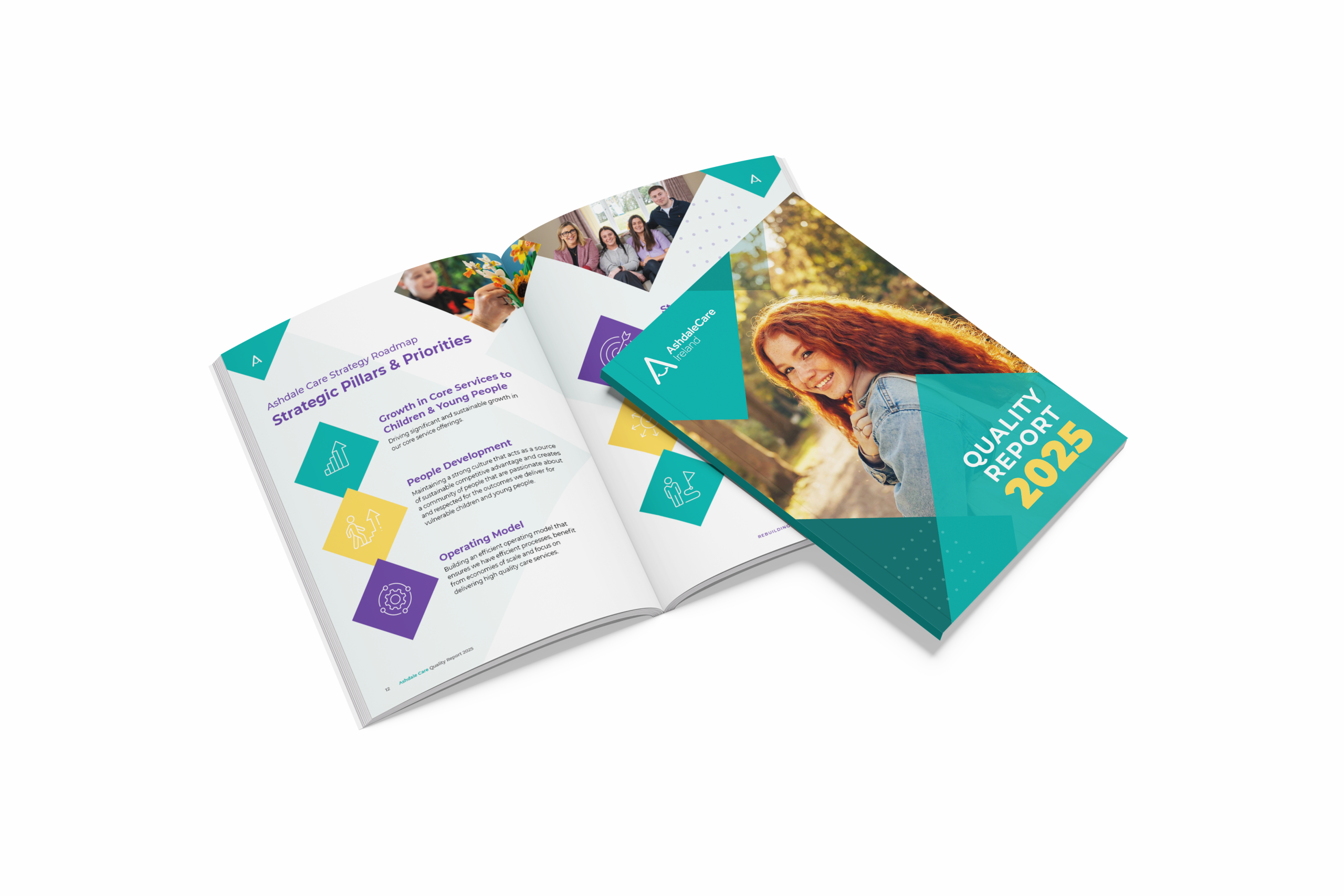
Discover our dedication in action. Download our Quality Report and explore how we uphold excellence in every aspect of our compassionate service to children and young people.